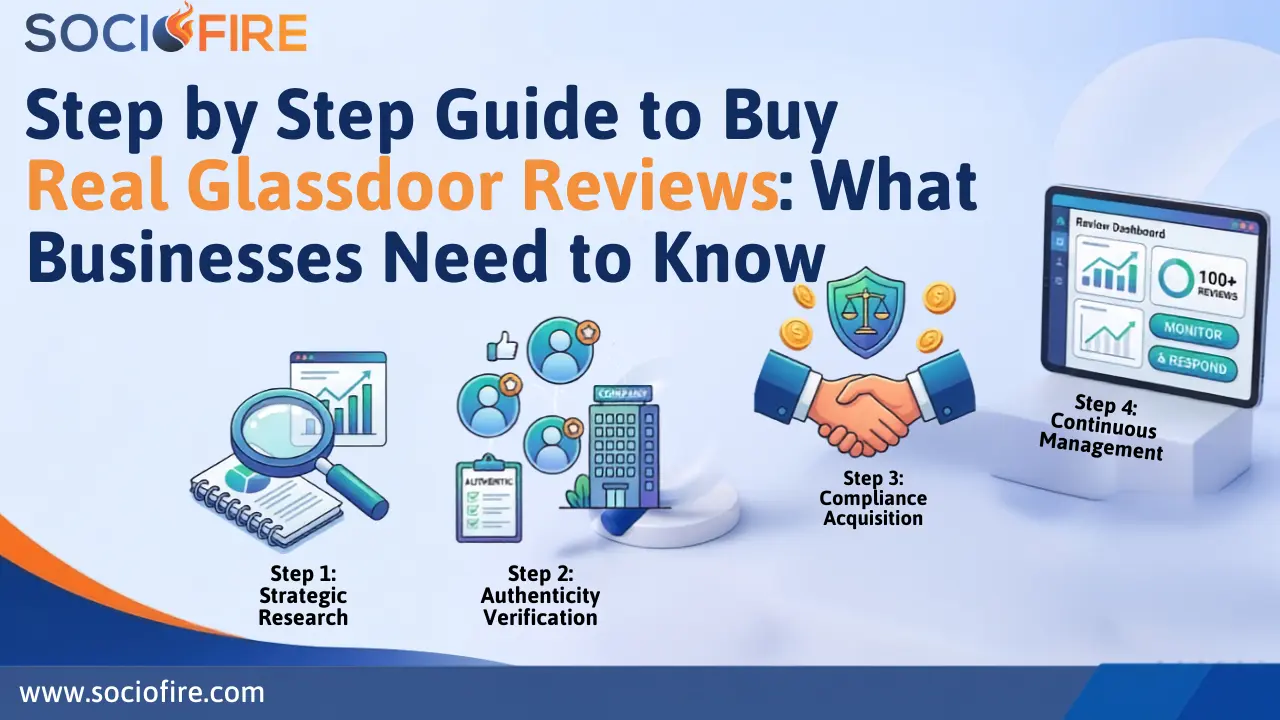
Step by Step Guide to Buy Real Glassdoor Reviews: What Businesses Need to Know
Glassdoor has become an important platform for companies that want to build trust with job seekers, attract qualified employees, and strengthen their employer brand. Before applying for a position, candidates often research a company’s workplace culture, management style, compensation, career opportunities, and employee experiences. As a result, a strong Glassdoor presence can influence how potential employees perceive a business.
This has also created growing interest in searches such as buy positive Glassdoor reviews, 5-star Glassdoor reviews, Glassdoor reviews for sale, bulk employee reviews, and improve Glassdoor rating fast.
Businesses with a low rating may naturally want a faster solution. Some review providers advertise large packages, real accounts, different employee profiles, USA-based reviewers, aged accounts, or supposedly permanent reviews. However, the important question is not simply whether a review can be published. The more important question is whether the review represents a genuine employment experience.
Glassdoor’s current policies place significant emphasis on authentic experiences and prohibit fabricated, misleading, impersonated, incentivized, or third-party-generated reviews presented as employee experiences. The source material also notes that Glassdoor can remove reviews and take action against accounts involved in review manipulation.
For businesses considering review services, understanding this distinction is essential.
This step-by-step guide explains what companies should know before purchasing Glassdoor review services, how to evaluate providers, why certain promises can be misleading, and what a sustainable reputation strategy should look like.
Step 1: Understand What “Buy Glassdoor Reviews” Actually Means
The phrase buy Glassdoor reviews can refer to several different services.
Some providers advertise review-writing packages where third parties create reviews and publish them on behalf of a company. Others may promote employee-feedback campaigns, reputation management, review monitoring, or strategies designed to increase the number of authentic reviews.
These services are not equivalent.
A legitimate reputation-management strategy focuses on helping a company collect, manage, understand, and respond to genuine feedback. A fabricated review strategy attempts to create the appearance of employee experiences that did not actually occur.
That difference matters.
A review can look completely natural while still being inauthentic. For example, a seller may offer:
- 5-star ratings
- Custom job titles
- Different employee locations
- Different reviewer names
- Aged accounts
- USA-based accounts
- Multiple reviews
- Bulk packages
- Custom-written content
- “Permanent” reviews
- Rating improvement guarantees
However, an account being real does not automatically mean the employment experience is real.
The source material makes this distinction particularly clear: a genuine person using a genuine account does not make a review authentic if that person never worked for the employer represented in the review.
Therefore, businesses should look beyond the sales description and ask:
Did the reviewer actually have the experience described?
That is the foundation of an authentic employer review.
Step 2: Decide Whether You Need Reviews or Reputation Management
Before searching for Glassdoor reviews for sale, identify the actual problem.
A low Glassdoor rating may be caused by:
- Genuine employee dissatisfaction
- Management issues
- Poor internal communication
- Compensation concerns
- Workload problems
- Limited career development
- Scheduling challenges
- A small number of reviews
- An unusually negative review period
- Outdated employee feedback
- Lack of responses from management
Buying additional positive ratings does not necessarily solve any of these underlying problems.
If employees consistently mention poor communication, adding positive reviews does not improve communication.
If workers complain about management, additional five-star ratings do not change management.
If employees are dissatisfied with career development, artificial ratings cannot create better career opportunities.
This is why the first step in a professional reputation strategy should be diagnosis.
Socio Fire can position its reputation services around understanding the reason behind negative employer sentiment, monitoring public feedback, identifying recurring complaints, and developing a legitimate strategy for improving employer reputation.
The objective should not simply be to change a number.
The objective should be to build a stronger employer brand.
Step 3: Be Careful With “Buy Positive Glassdoor Reviews” Services
The keyword to buy positive Glassdoor reviews represents strong commercial intent. A company searching for this term is usually looking for a quick way to increase positive sentiment.
However, businesses should understand the risks before purchasing such services.
Glassdoor’s current rules prohibit fabricated reviews and misleading representations of an individual’s relationship with an employer. The source also identifies third-party review writing and other forms of manipulation as activities that can result in removal.
A provider may claim that its reviewers are:
- Real people
- Real accounts
- Experienced writers
- Based in the United States
- Using unique IP addresses
- Using aged profiles
None of these factors independently establish that the person genuinely worked for the company.
A real person can still provide a false employment experience.
A real account can still be used to publish misleading content.
An aged profile can still publish an inauthentic review.
Therefore, companies should avoid evaluating review providers solely based on how convincing the profiles appear.
Authenticity should be the primary consideration.
Step 4: Understand the Reality Behind 5-Star Glassdoor Reviews
The search for 5-star Glassdoor reviews is understandable when a company wants to improve its employer image.
However, a profile containing only exceptionally positive reviews can create another problem: it may appear unnatural.
Real workplaces contain different teams, managers, departments, personalities, and employee experiences. Consequently, genuine reviews can naturally include both strengths and weaknesses.
For example, an authentic review may say that a company provides strong mentorship while also noting that internal communication could improve.
Another employee might have a completely different perspective.
This variation is not necessarily a weakness.
In fact, balanced feedback can make an employer profile more credible.
The source material notes that an unnaturally perfect collection of positive reviews can make sophisticated candidates suspicious.
Therefore, businesses should not make “100% five-star” their only reputation objective.
A better objective is credible employee sentiment.
Step 5: Evaluate Claims About Glassdoor Reviews for Sale
Businesses searching for Glassdoor reviews for sale will encounter a wide range of providers.
Some sellers may advertise packages based on review quantity.
For example:
- 10 reviews
- 25 reviews
- 50 reviews
- 100 reviews
- Monthly review packages
- Bulk employee reviews
- Five-star campaigns
Quantity may sound attractive, but quantity does not establish authenticity.
A company should ask:
- Who writes the reviews?
- Did those people actually work for the company?
- Are the reviews incentivized?
- Are third parties writing them?
- Are multiple accounts being used?
- Is the content based on genuine experiences?
- What happens if Glassdoor removes the content?
- Can the provider actually guarantee continued publication?
These questions are more valuable than simply asking how many reviews a package contains.
Glassdoor currently limits a user to one review per company per year, and its policies also prohibit multiple accounts being used to create additional reviews for the same company.
That makes bulk-review promises particularly important to scrutinize.
Step 6: Be Careful With Bulk Employee Reviews
Bulk employee reviews can sound like an efficient reputation strategy.
A business may think that adding dozens of reviews quickly will dilute older negative feedback and increase its average rating.
But an unusually concentrated increase in reviews can create questions about authenticity.
For example, imagine an employer has 40 reviews accumulated over several years.
Then, within a short period, 30 highly positive reviews appear.
Even if the ratings technically increase, the sudden pattern may not resemble normal employee activity.
The source material specifically explains that bulk campaigns can increase the manipulation concern rather than eliminate it.
A better approach is to create a sustainable employee-feedback process.
Instead of trying to manufacture dozens of reviews at once, businesses can:
- Invite employees to share honest experiences voluntarily
- Make review participation optional
- Avoid requesting a specific rating
- Avoid rewarding reviews
- Avoid selecting only satisfied employees
- Avoid requesting screenshots
- Respect employee anonymity
- Monitor recurring feedback themes
- Address legitimate workplace concerns
This approach creates a healthier foundation for long-term employer reputation.
Step 7: Understand What “Verified Glassdoor Reviews” Really Means
Verified Glassdoor Reviews is another attractive commercial keyword.
However, businesses should be cautious about assuming that “verified” in a seller’s marketing means that Glassdoor has independently verified the reviewer’s complete employment history.
Glassdoor uses several mechanisms to protect review integrity, including account validation, technology, algorithms, IP-related analysis, and human moderation. At the same time, Glassdoor acknowledges that it cannot completely verify every user’s identity, employment relationship, or every detail of every contribution.
Therefore, businesses should ask review providers exactly what they mean by “verified.”
Does it mean:
- A verified account?
- A real person?
- A verified employment relationship?
- A legitimate former employee?
- Human-written content?
- Identity verification?
These are different concepts.
A provider should never imply that its own verification process overrides Glassdoor’s moderation system.
Step 8: Don't Assume Real Accounts Mean Real Reviews
One common marketing claim is that a company can receive reviews through “real Glassdoor accounts.”
At first glance, this may appear safer than fake accounts.
But account authenticity and review authenticity are separate issues.
Imagine someone has a genuine Glassdoor account but has never worked for your organization.
If that person publishes a review describing themselves as your former employee, the account may be genuine, but the employment experience is not.
This is why businesses should be cautious about services that focus heavily on:
- Aged accounts
- Real profiles
- Real users
- Account history
- Unique devices
- Unique IP addresses
Those characteristics do not establish a genuine employer-employee relationship.
The source material specifically explains that “real account” and “real employee” are completely different claims.
Step 9: Question “Improve Glassdoor Rating Fast” Promises
Many companies searching to improve Glassdoor rating fast are under pressure.
Perhaps the company is recruiting aggressively.
Perhaps a competitor has a much higher employer rating.
Perhaps negative reviews are appearing in search results.
Perhaps executives want the company’s rating improved before an important hiring campaign.
These situations can create an incentive to pursue quick solutions.
But reputation is rarely improved sustainably by manipulating a rating.
Consider a simple example.
A company has:
- 50 genuine reviews
- Average rating: 3.0
The company then receives 25 additional five-star reviews through an artificial campaign.
Mathematically:
- 50 × 3.0 = 150 rating points
- 25 × 5.0 = 125 additional points
- Total = 275 points
- Total reviews = 75
- 275 ÷ 75 = approximately 3.67
The rating appears to improve.
But if those artificial reviews are later removed, the company can return toward its original rating.
The source material uses this same type of illustration to demonstrate that changing the number does not necessarily change the underlying employee experience.
The sustainable solution is therefore not simply:
“How can we increase the rating?”
It is:
“How can we improve the employee experience and generate more genuine feedback?”
Step 10: Understand Why Permanent Glassdoor Reviews Are Not Guaranteed
Another common sales phrase is Get Permanent Reviews.
A provider may claim:
- Permanent Glassdoor reviews
- Lifetime reviews
- Never-deleted reviews
- 100% permanent reviews
- Guaranteed reviews
- Permanent rating increase
Businesses should be careful with these promises.
An outside provider does not control Glassdoor’s moderation decisions.
Glassdoor can remove content that violates its policies, and it can take action against accounts involved in review-integrity violations.
Therefore, a third-party seller cannot legitimately guarantee that a review will remain published indefinitely.
A review that appears today can potentially be reviewed or removed later.
This is an important distinction when evaluating any Get Permanent Reviews service.
A more responsible reputation-management provider should focus on sustainable processes rather than guaranteeing permanent third-party content.
Step 11: Understand the Risks of Buying Glassdoor Reviews
Before Buying Glassdoor Reviews, businesses should understand the possible consequences.
Review Removal
Glassdoor can remove reviews that violate its policies.
The source identifies fake reviews, multiple accounts, impersonation, reviews submitted on behalf of others, incentivized reviews, third-party review writing, and coercion among activities that can result in removal.
Reputation Damage
If employees or candidates discover that a company has attempted to manipulate its employer rating, the resulting trust problem may be worse than the original low rating.
Candidate Suspicion
An employer profile filled with unusually similar positive reviews can look less credible.
Wasted Investment
If paid reviews are removed, the business loses the money spent on the campaign without fixing the original reputation problem.
Account Restrictions
Review-integrity violations can also result in restrictions on content-submission privileges.
Public Reputation Alerts
In serious cases, Glassdoor may display an “Inflated Reviews” alert when it identifies evidence of aggressive rating manipulation.
This creates an important lesson:
Trying to improve an employer rating artificially can potentially turn a rating problem into a trust problem.
Step 12: Know the Difference Between Asking for Reviews and Buying Reviews
Businesses do not have to remain passive about employee feedback.
There is an important difference between requesting honest reviews and buying positive reviews.
A company can encourage employees to share their genuine experiences as long as the process is voluntary and neutral.
For example, a business can communicate:
- “We value honest employee feedback. If you’d like to share your experience working here, you’re welcome to leave a Glassdoor review. Participation is completely voluntary.”
That is fundamentally different from:
- “Leave us a five-star review and receive a bonus.”
Glassdoor’s current employer guidance distinguishes voluntary requests for genuine feedback from incentives, coercion, and selective review campaigns.
The goal should therefore be to create opportunities for authentic employee feedback rather than manufacture predetermined outcomes.
Step 13: Never Pressure Employees to Leave Positive Reviews
A reputation campaign should not tell employees what rating to provide.
Avoid instructions such as:
- “Please give us five stars.”
- “Only leave a positive review.”
- “Mention these benefits.”
- “Do not mention management issues.”
- “Send HR a screenshot.”
- “Everyone must leave a review.”
Instead, employees should be free to decide whether they want to participate and what they want to say.
The source material notes that employers should not cherry-pick only happy employees or pressure employees toward positive feedback.
Authentic feedback is valuable precisely because employees have the freedom to express their own perspectives.
Step 14: Avoid Incentives for Glassdoor Reviews
A company might consider offering:
- Gift cards
- Bonuses
- Extra vacation
- Cash
- Prizes
- Other benefits
in exchange for reviews.
However, Glassdoor’s current rules specifically prohibit review incentives. The source material identifies gift cards, bonuses, time off, and other rewards as examples of prohibited incentives.
Therefore, businesses should separate employee rewards from review activity.
Employees should never feel that their compensation or benefits depend on whether they publish a review.
Step 15: Don't Ask Employees for Screenshots
Another mistake businesses sometimes make is requesting proof that employees completed a review.
For example:
- “Send HR a screenshot after you post.”
This can undermine the employee’s sense of anonymity and create pressure around the review process.
Glassdoor’s guidance says employers should not require proof that employees submitted reviews.
A legitimate review process should allow employees to participate without having to demonstrate that they did so.
Step 16: Don't Organize Review Sessions on Company Computers
A business might organize an internal meeting where employees are asked to log into Glassdoor and leave reviews.
This may seem efficient, but it can create additional authenticity and privacy concerns.
Glassdoor’s current integrity guidance says employers should not require employees to write reviews using shared company equipment or in a controlled workplace environment.
Employees should be able to make their own decisions independently.
The purpose of employer reputation management should be to facilitate genuine feedback—not control the environment in which that feedback is created.
Step 17: Analyze Negative Glassdoor Reviews Instead of Automatically Removing Them
Negative reviews can be uncomfortable.
However, not every negative review is a reputation crisis.
Some criticism may identify legitimate issues that the company should address.
Look for recurring themes.
For example:
- Management: Are several employees describing the same management problem?
- Workload: Are workers repeatedly reporting excessive workloads?
- Communication: Are departments struggling with communication?
- Career Growth: Do employees feel they have limited opportunities for promotion?
- Compensation: Are compensation concerns appearing repeatedly?
- Scheduling: Are employees consistently unhappy with scheduling practices?
When several independent reviews identify the same issue, that information can become valuable organizational feedback.
A company that addresses the root cause has a better chance of generating positive employee sentiment organically.
Step 18: Build a Genuine Review Strategy Instead of Buying Reviews
If your goal is to strengthen your employer reputation, develop a long-term feedback strategy.
A sustainable approach can include:
- Monitor Reviews: Track new Glassdoor reviews and identify recurring themes.
- Categorize Feedback: Separate feedback into areas such as management, compensation, culture, workload, communication, and growth.
- Identify Patterns: One complaint may be isolated. Repeated complaints may indicate a systemic issue.
- Improve Internal Processes: Address legitimate problems identified through employee feedback.
- Encourage Voluntary Participation: Employees who want to share their experience can be invited to do so without pressure.
- Maintain Neutrality: Do not dictate ratings or specific talking points.
- Respond Professionally: Respond to reviews professionally and respectfully when appropriate.
- Measure Long-Term Change: Monitor whether genuine employee sentiment improves over time.
This is much more sustainable than attempting to create artificial rating spikes.
Step 19: How Socio Fire Can Help With Employer Reputation
Socio Fire can be positioned as a reputation-management partner for businesses that want to strengthen their online employer presence without relying on misleading review practices.
Rather than focusing exclusively on Buying Glassdoor Reviews, a professional strategy can focus on:
- Employer reputation monitoring
- Review analysis
- Reputation improvement strategy
- Employee feedback processes
- Review-response management
- Negative sentiment analysis
- Employer-brand development
- Genuine review acquisition strategies
- Online reputation monitoring
- Search-result reputation management
The objective is to help companies develop a stronger and more credible public presence.
A reputation campaign should not simply make an employer look better for a few weeks.
It should help create a reputation that can withstand scrutiny from candidates, employees, recruiters, and other stakeholders.
Step 20: Choose a Glassdoor Review Provider Carefully
If you are evaluating a company that offers Glassdoor-related services, ask detailed questions before signing a contract.
- Ask What the Service Actually Provides: Does the company provide reputation monitoring and genuine review management, or does it promise fabricated reviews?
- Ask About Review Authenticity: Can reviewers genuinely confirm that they have worked for the company?
- Ask About Compliance: Does the provider understand Glassdoor’s current review-integrity requirements?
- Avoid Guaranteed Permanent Reviews: No third-party provider controls Glassdoor’s moderation system.
- Avoid Guaranteed Five-Star Ratings: Real employee experiences cannot ethically be predetermined.
- Ask About Reporting: A professional provider should be able to explain what activities it performs and how success is measured.
- Ask About Long-Term Strategy: The best reputation strategy should not depend entirely on adding reviews.
It should improve the employer’s overall reputation.
Bulk Glassdoor Reviews vs. Genuine Employee Feedback
The difference between artificial volume and genuine feedback is significant.
| Factor | Bulk Purchased Reviews | Genuine Employee Reviews |
| Employment experience | May be absent | Based on actual experience |
| Payment | Often involved | Not required |
| Reviewer independence | Potentially weak | Stronger |
| Authenticity | High risk | Higher when policy-compliant |
| Removal risk | Higher | Lower when compliant |
| Candidate trust | Can be damaged | Can improve |
| Long-term value | Uncertain | More sustainable |
| Employer insight | Limited | Valuable |
| Reputation strength | Potentially fragile | More defensible |
A large number of reviews is not automatically better.
The quality and authenticity of employee feedback matter more than artificial volume.
Why “Get Permanent Reviews” Is Not the Best Reputation Goal
Businesses sometimes focus heavily on the word “permanent.”
But permanence should not be the primary objective.
A better question is:
Will the reputation remain strong even when new employees continue to share their experiences?
If the answer is yes, the company has built something valuable.
If the reputation depends on continuously purchasing reviews, the underlying problem remains.
A strong employer reputation should be capable of surviving genuine feedback.
That is why Socio Fire can focus on helping companies build sustainable reputation systems rather than simply promising permanent third-party content.
Can You Improve Glassdoor Rating Fast Without Buying Reviews?
Yes, but the speed of improvement depends on the underlying situation.
A practical strategy can involve several areas simultaneously.
- Address Major Complaints: Identify recurring employee concerns and prioritize those with the largest impact.
- Improve Internal Communication: Clear communication can improve employee confidence and reduce frustration.
- Strengthen Management: Managers have a major influence on workplace experience.
- Improve Career Development: Training, mentorship, and promotion opportunities can contribute to employee satisfaction.
- Encourage Honest Feedback: Employees should have safe channels for sharing concerns internally.
- Invite Voluntary Glassdoor Feedback: Employees who genuinely want to share their experiences can do so voluntarily.
- Respond Professionally: Thoughtful responses can demonstrate that management listens.
This strategy may not produce an instant rating change, but it creates a foundation for sustainable improvement.
What Does a Genuine Glassdoor Reputation Look Like
A credible employer profile does not necessarily have to contain only five-star reviews.
It may include:
- Positive reviews
- Mixed reviews
- Constructive criticism
- Different perspectives
- Different departments
- Different job roles
- Different career stages
What matters is whether the reviews represent genuine employee experiences.
A company with a 4.1 rating and believable feedback may be more trustworthy than a company with an artificially perfect 5.0 profile.
Candidates are capable of reading between the lines.
They may look at:
- Review detail
- Recurring themes
- Management responses
- Recent reviews
- Pros and cons
- Job-specific experiences
- Career development comments
- Workplace culture
Therefore, reputation management should consider the entire profile rather than a single rating.
The Biggest Mistake in Buying Glassdoor Reviews
The biggest mistake is assuming that the rating is the reputation.
It is not.
The rating is only one component.
Employer reputation also includes:
- Employee experiences
- Candidate perception
- Management credibility
- Workplace culture
- Public responses
- Review consistency
- Brand perception
- Search visibility
- Leadership reputation
If a company increases its rating but candidates do not trust the reviews, the strategy has failed.
If a company receives more positive feedback because its workplace genuinely improves, the strategy has succeeded.
That is the difference between manipulating a metric and building a reputation.
A Better Step-by-Step Glassdoor Reputation Process
Here is a practical framework businesses can follow.
Step 1: Audit the Existing Profile
Review ratings, recent reviews, recurring complaints, and management responses.
Step 2: Identify Reputation Problems
Determine whether negative sentiment comes from isolated incidents or recurring issues.
Step 3: Prioritize Internal Improvements
Address the issues that most directly affect employee experience.
Step 4: Establish an Ethical Review Process
Invite employees to provide honest feedback voluntarily.
Step 5: Avoid Incentives
Do not provide compensation or rewards for reviews.
Step 6: Avoid Review Selection
Do not ask only satisfied employees to participate.
Step 7: Protect Employee Independence
Do not demand screenshots or force employees to use company equipment.
Step 8: Monitor New Feedback
Track review sentiment over time.
Step 9: Respond Professionally
Use appropriate responses to demonstrate that the organization takes feedback seriously.
Step 10: Measure Sustainable Reputation Growth
Look beyond rating changes and evaluate candidate perception, review quality, employee sentiment, and brand trust.
Frequently Asked Questions About Buying Glassdoor Reviews
Can You Buy Glassdoor Reviews Online?
Third-party companies may advertise Glassdoor reviews for sale, but purchasing fabricated or misleading reviews creates significant integrity and reputation risks. Glassdoor’s current policies focus on authentic employment experiences and prohibit various forms of fabricated and manipulated review activity.
Can I Buy Positive Glassdoor Reviews?
A seller may advertise buy positive Glassdoor reviews, but businesses should not purchase fabricated reviews that pretend to represent genuine employees. A safer approach is to develop a voluntary and authentic employee-feedback strategy.
Can I Buy 5-Star Glassdoor Reviews?
Providers may advertise 5-star Glassdoor reviews, but a business should not attempt to manufacture a predetermined rating through fabricated employee experiences. Authentic employees should be free to provide their own ratings and opinions.
Are Glassdoor Reviews for Sale Safe?
There is no universal safety guarantee for purchased reviews. Glassdoor uses technology, account validation, IP-related analysis, algorithms, and human moderation as part of its review-integrity process.
What Are Bulk Employee Reviews?
Bulk employee reviews generally refers to campaigns designed to generate a large number of reviews in a short period. Businesses should be cautious because a sudden concentration of reviews can raise authenticity concerns.
Can Bulk Glassdoor Reviews Improve a Rating?
Additional reviews can mathematically affect an average rating, but artificial reviews do not solve the underlying employee-experience problems. If such reviews are removed, the rating may move back toward its genuine level.
Are Verified Glassdoor Reviews Safe to Buy?
The term Verified Glassdoor Reviews should be examined carefully. A real account or real person does not necessarily mean the person genuinely worked for the employer represented in the review.
Can I Get Permanent Reviews?
No third-party provider can guarantee that a review will remain on Glassdoor permanently. Glassdoor controls its own moderation and content policies.
Can Socio Fire Help Improve Employer Reputation?
Yes. Socio Fire can provide reputation-management strategies focused on monitoring employee feedback, analyzing sentiment, managing responses, and developing legitimate approaches for strengthening employer reputation.
How Can I Improve Glassdoor Rating Fast?
Start by identifying the reasons behind negative employee sentiment. Address recurring workplace issues, invite broad and voluntary employee feedback, and maintain professional review responses. A sustainable improvement strategy is more valuable than an artificial short-term rating increase.
Can Employees Be Asked to Leave Glassdoor Reviews?
Yes, companies can invite employees to share their genuine experiences voluntarily. However, employers should not pressure employees, demand specific ratings, provide incentives, selectively target only positive employees, or require proof of submission.
Can Employees Receive Gift Cards for Reviews?
Glassdoor’s current employer guidance identifies gift cards and similar rewards as prohibited incentives for reviews.
Can Employers Ask Employees for Screenshots?
Employers should not require employees to provide proof that they submitted a review. This can create pressure and interfere with the independence of employee feedback.
Can One Employee Post Multiple Glassdoor Reviews?
Glassdoor currently limits users to one review per company per year. Updating a review archives the previous submission and publishes the newer version.
Can Multiple Accounts Be Used for Bulk Reviews?
Using multiple accounts to create additional reviews for the same company violates Glassdoor’s review-integrity rules.
Can Glassdoor Remove Purchased Reviews?
Yes. Reviews that violate Glassdoor’s integrity and Community Guidelines can be removed, including fabricated, impersonated, incentivized, or third-party-generated reviews presented as authentic experiences.
What Is an Inflated Reviews Alert?
Glassdoor may display an Inflated Reviews alert when it finds evidence of aggressive attempts to artificially increase an employer’s rating through review manipulation.
Should Businesses Buy Glassdoor Reviews to Balance Negative Reviews?
A better strategy is to generate genuine employee feedback, respond professionally to criticism, and address recurring workplace concerns. Buying artificial reviews can create additional credibility and compliance risks.
Final Verdict: Should You Buy Glassdoor Reviews?
The demand for Buying Glassdoor Reviews exists because businesses understand how important employer reputation has become.
A low Glassdoor rating can affect candidate perception, recruitment, employer branding, and overall trust. That naturally makes keywords such as buy positive Glassdoor reviews, 5-star Glassdoor reviews, Glassdoor reviews for sale, bulk employee reviews, Verified Glassdoor Reviews, Bulk Glassdoor Reviews, Get Permanent Reviews, and improve Glassdoor rating fast highly attractive to businesses looking for solutions.
However, the fastest-looking solution is not always the safest or most sustainable one.
Fabricated reviews can create risks involving authenticity, removal, candidate trust, and employer reputation. Glassdoor’s current policies specifically address fabricated reviews, multiple accounts, misleading employment relationships, incentives, coercion, and third-party review manipulation.
The better strategy is to build a reputation that genuine employees can support.
That means improving the employee experience, encouraging voluntary and honest feedback, responding professionally to criticism, monitoring reputation trends, and addressing recurring workplace problems.
Socio Fire can help businesses approach employer reputation as a long-term brand asset rather than simply a rating that needs to be artificially increased.
A strong Glassdoor presence is not created by making an employer look perfect.
It is created by making the employer credible, transparent, responsive, and genuinely better.
And ultimately, that is what candidates are looking for when they research a company before deciding whether they want to work there.
Frequently Asked Questions
Is it possible to buy positive Glassdoor reviews?
Businesses may look for positive Glassdoor reviews to improve their online reputation. However, reviews should ideally come from genuine employees or people with real experience with the company.
How can 5-star Glassdoor reviews improve a company’s reputation?
Authentic 5-star Glassdoor reviews can strengthen employer credibility and create a more positive impression among potential employees. Consistent genuine feedback can also support a stronger employer brand.
Are Glassdoor reviews for sale legitimate?
Some services advertise Glassdoor reviews for sale, but businesses should carefully evaluate their authenticity and compliance with Glassdoor policies. Genuine employee feedback is the safer long-term approach.
What are bulk employee reviews?
Bulk employee reviews refer to multiple reviews provided or submitted for a company within a short period. Businesses should prioritize authentic feedback rather than artificially generating large volumes of reviews.
How can a company get more positive Glassdoor reviews?
Companies can encourage genuine employees to share honest experiences on Glassdoor. Improving workplace culture, addressing employee concerns, and requesting voluntary feedback can help generate authentic positive reviews.