Snap Yellow Heart Decoded: Why You Got It, How to Keep It and the Gold Heart Confusion
The meaning of yellow heart in snapchat states that you two are each other’s best friends. You two send each other the greatest number of snaps than anyone else. It is totally dependent on in-app interaction, mutual, and exclusive. There is a catch, though.
No, it isn’t necessarily romantic; it’s an engagement metric dressed as a tiny icon. Curious how it arrived there? Read on.
How Snapchat determines the yellow heart
Snap’s friend-emoji system ranks who you interact with most. The yellow heart appears when both users top each other’s “most snapped” list. In other words, it’s mutual. If you’re wondering whether DMs, Story views, or posting frequency count, Snap focuses on direct snaps (and chat/snaps) exchanged between two people.
Wondering why mutual? Because friendship ranking is asymmetric unless both sides are actively snapping back. Want to lose your yellow heart? Stop sending snaps or they might.
Yellow heart vs. red heart vs. pink hearts (timeline)
Snapchat upgrades the yellow heart as a friendship endures. Here’s the simple progression:
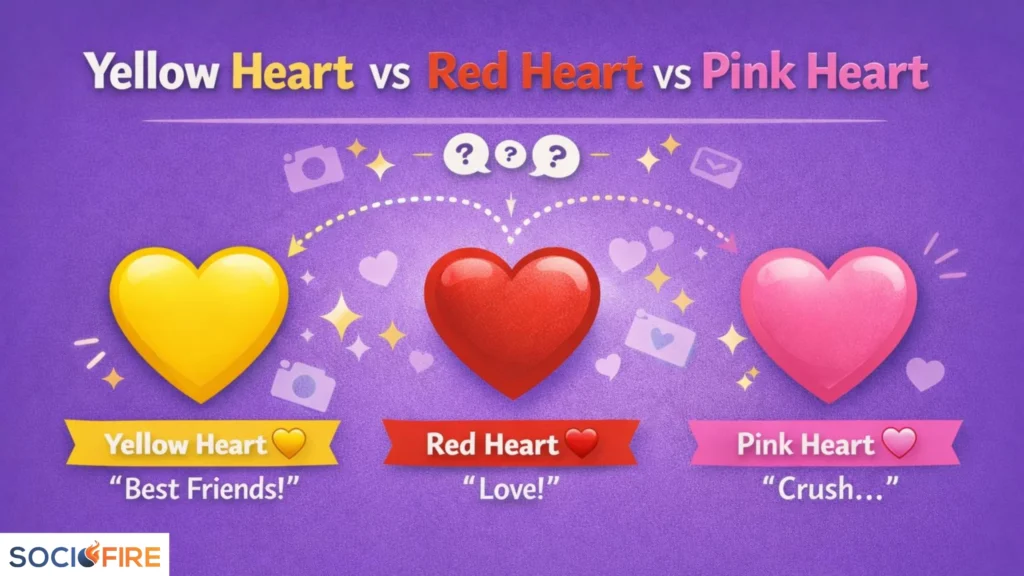
Yellow Heart
Emoji: 💛
Meaning: You’re mutual #1 Best Friends (top snap senders to each other).
Time to appear: Immediate once mutual top status is reached.
Red Heart
Emoji: ❤️
Meaning: You’ve been #1 Best Friends for 2 weeks straight.
Time to appear: 2 weeks after the yellow heart.
Two Pink Hearts
Emoji: 💕
Meaning: You’ve held #1 Best Friends 2 months in a row.
Time to appear: 2 months after red heart.
That timeline matters because the yellow heart is the gateway. It is the visible sign your interaction is at the top. Want the red heart? Consistency for 14 days. Want the pink hearts? Double down for 60.
Why the yellow heart matters (for friendships, privacy, and social signaling)
The snap yellow heart is small but powerful. For many users it’s:
- Social proof – others can’t see your friend emojis, but you know who you engage with most. That knowledge shapes behavior.
- A privacy win – best-friend rankings are private; emojis are only visible to you. Curious who’s top? Only you can see it.
- A behavioral nudge – the icon nudges people to interact more (and sometimes to interpret relationships through a romantic lens).
Is that last point manipulative? Maybe but it’s also just how social apps encourage engagement.
Common misunderstandings (romance vs. friendship)
A lot of people have a question which is, “Does the yellow heart mean they like me?” The short answer is not necessarily as close friends and even co-workers who swap snaps all day can earn a yellow heart.
Want to be sure? Look at the content and context of snaps, not just the heart.
Can you “game” the yellow heart?
Yes, technically. If you and someone agree to snap each other repeatedly, the algorithm will treat that as increased interaction, and the yellow heart can appear. But beware:
- Fragile gains. Stop snapping and the ranking changes.
- Inauthentic engagement. Manufactured snaps won’t build real rapport; they just inflate a number which doesn’t make any sense.
If your goal is relationship quality, don’t game the system; prioritize meaningful interaction.
Related icons you should know
Here’s a compact table of other friend emojis you’ll see (so you don’t confuse gold/yellow language):
⭐ Gold/Star: Someone has replayed this person’s Snap in the last 24 hours.
😊 Smiley face: One of your Best Friends (you snap them a lot but not necessarily #1).
🔥 Fire (streak): You and a friend have snapped each other for consecutive days.
⌛ Hourglass: A Snapstreak is about to expire, so act fast.
💛 Yellow Heart: Mutual #1 Best Friends (explained above).
Note: Some sites call the yellow heart the “gold heart” casually, but on the app it’s shown as yellow. Emojipedia and Snap explain the semantics clearly.
Emoji customization: can you change friend emojis?
Yes, you can customize friend emojis (or restore defaults) via Snapchat settings if you prefer different symbols. Customization doesn’t change the underlying logic, only the picture you see. To tweak them: Settings → Additional Services → Manage → Friend Emojis.
Why customize? Branding, inside jokes, or avoiding awkward assumptions about what a yellow heart might “mean.”
Practical tips: how to keep or lose a yellow heart (3 quick steps)
- To keep a yellow heart: Snap regularly with that person. Short snaps count and consistency matters.
- To lose a yellow heart: Reduce snaps, or diversify who you send snaps to as the ranking shifts to whoever you interact with most.
- To avoid confusion: Talk. If an emoji creates drama, a 30-second conversation clears it. Which one will you try?
These steps are actionable today, not just theory.
Mini-case: the “work bestie” who became a yellow heart
A friend told me she woke up to a yellow heart next to her colleague’s name and panicked until she remembered they’d been snapping funny office memes all week. The heart didn’t mean romance; it meant shared, frequent micro-moments. She laughed, deleted an awkward DM, and started sending lunch photos instead. The moral? Context beats the icon every time.
Troubleshooting: common scenarios and likely outcomes
Scenario 1: You and a friend snap each other a lot for a week
What likely happens: Yellow heart appears quickly
How to respond: Keep it with authentic snaps or reduce frequency to remove it
Scenario 2: Someone else starts snapping your friend more
What likely happens: Your yellow heart may disappear
How to respond: Accept the shift or increase meaningful snaps if desired
Scenario 3: You see a “gold heart on snapchat” term used elsewhere
What likely happens: People sometimes misname the icon
How to respond: Clarify that the app shows a yellow heart visually; educate others
Scenario 4:Custom friend emoji set hides the yellow heart
What likely happens: Visual may change but logic stays
How to respond:Check Settings → Friend Emojis to verify underlying statuses
Brand & creator playbook (bite-sized tactics)
- For creators: Don’t chase yellow hearts. Instead, design short, shareable snaps that invite replies which build real relationships. Want ideas? Polls, quick behind-the-scenes clips, and call-to-reply hooks work.
- For community managers: Use friend-emoji patterns as a soft signal of your brand’s superfans (people who reply the most).Reward them with exclusive content or a shoutout but don’t leak private emoji data. Keep it respectful.
- For parents/guardians: Treat the yellow heart as an engagement metric, not proof of a relationship. Ask questions about content rather than the emoji to understand who your child communicates with.
Privacy & emotional health notes
Emojis can amplify insecurity. If a yellow heart causes stress, step back and assess patterns of communication rather than symbols. That’s healthier and more informative. Want a simple rule? Focus on the content of connections, not the icon.
Closing – why Socio Fire mentions this
Understanding the use cases of the yellow heart on Snapchat helps content creators, community managers, and everyday users read engagement signals more calmly. At Socio Fire, we teach brands to interpret social signals, like emojis and engagement metrics and turn them into sensible community strategies, not emotional landmines. Socio fire helps creators build authentic interaction that scales, not just chase icons.
Would you like Socio Fire to audit your Snapchat (or social) engagement and show you how to grow authentic top-friends, not just emoji counts? Comment below.
Do screenshots or story views create a yellow heart?
No, direct snaps and chats carry the most weight; story views are weaker.
Do Replays or video length matter?
Replays can signal interest but aren’t as heavy as regular swaps; longer videos don’t necessarily beat frequent short snaps. Which matters to you?
Does being mutual on other platforms affect Snapchat?
Nope, the ranking is internal to Snapchat. Want influence across apps? Use cross-platform content, but treat emojis as platform-specific signals.